

Cash is essential: it is liquid, stable in nominal terms and available the moment you need it. But being the safest place to keep money you may need soon is different from being a long-term strategy for growing or generating income. Over longer horizons, cash faces opportunity cost and inflation risk. The useful question is not cash or investments, but how much of each, and for what job.
Key takeaways
- ▹Cash does important jobs (liquidity, near-term obligations and nominal stability) that investments cannot replace.
- ▹The opportunity cost of holding cash changes with interest rates and with inflation.
- ▹Income investments offer different return potential in exchange for different risks; they complement cash rather than replace it entirely.
What cash does well
Cash and insured deposits are unmatched for three things: immediate liquidity, stability of nominal value, and safety for money you cannot afford to put at risk. An emergency fund, a near-term expense, a down payment due next year: these belong in cash or insured deposits, where bank deposits are protected up to FDIC limits.
For these purposes, the return on cash is almost beside the point. The job is availability and certainty, and cash does that job better than any investment.
What cash does not do
Over long horizons, cash has two limitations. First, opportunity cost: money kept in cash is not earning the higher potential return of income-producing investments. Second, inflation risk: even when cash pays interest, rising prices can erode its purchasing power over time, so a dollar held for years may buy less later.
This is not an argument against holding cash. It is a reason not to hold more of it, for longer, than your near-term needs require, because cash held as a long-term strategy quietly gives up both income and purchasing power.
Cash, Treasuries, public bonds and private credit
Each option is suited to a different job. Reading across, higher income potential generally comes with lower liquidity and different, not zero, risk. Comparing only the yields would miss the differences in insurance, term and access that actually determine which asset fits which need.
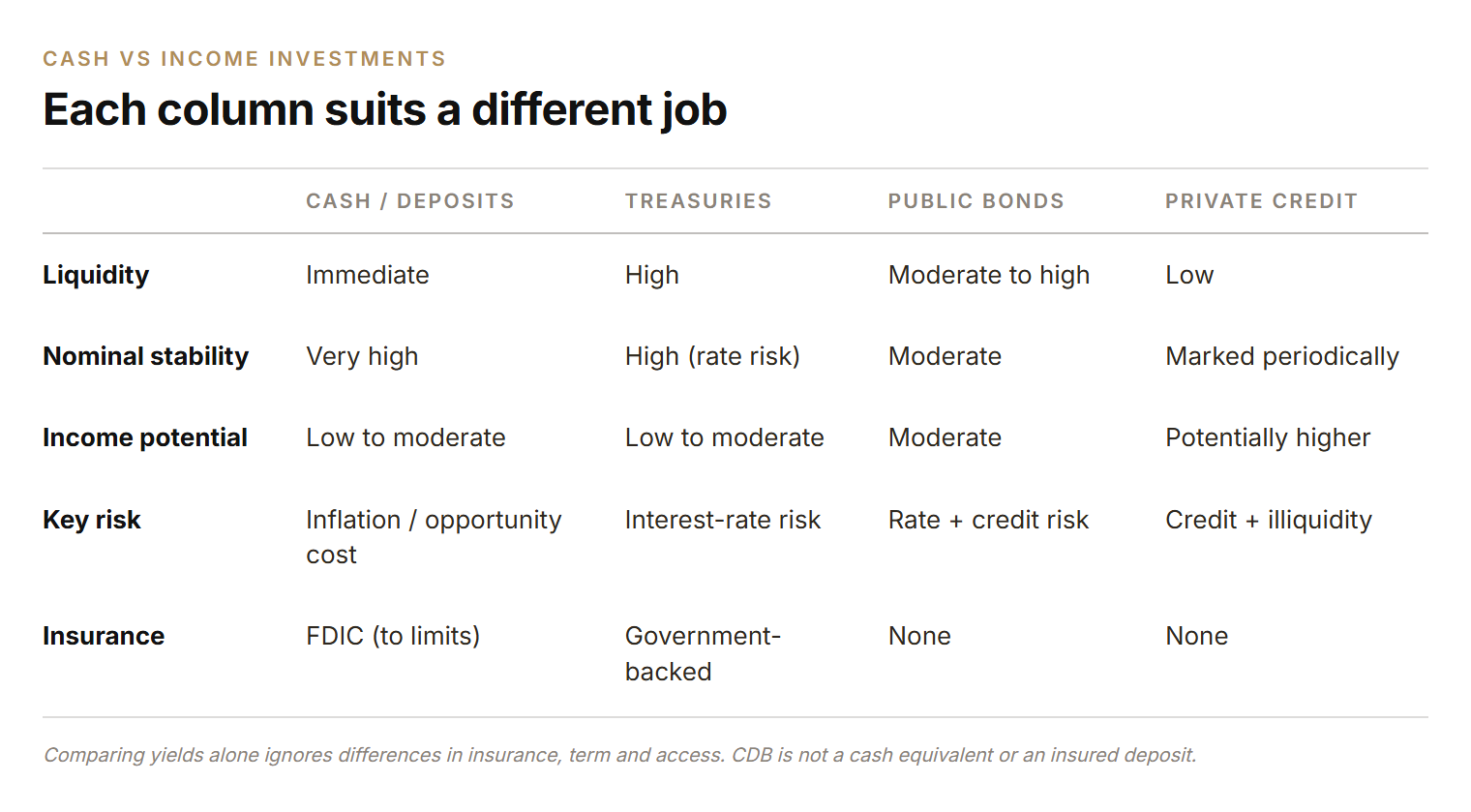
The importance of matching liquidity to time horizon
A sound way to organize money is by when you will need it. Money needed within, say, a year belongs in cash or near-cash. Money not needed for several years can accept less liquidity in exchange for higher income potential. Mismatching the two (locking up money you will need soon, or parking long-term money in cash) is one of the most common and costly portfolio mistakes.
Why an income portfolio can include cash rather than replace it
Well-built income portfolios hold cash and liquid assets on purpose. Liquidity lets a portfolio meet obligations, manage redemptions and seize opportunities without forced selling. So the choice is rarely cash versus an income portfolio; a thoughtful income portfolio contains a liquidity sleeve of its own.
How CDB uses Treasuries and liquidity alongside private-market income
Compound Diversified Bond illustrates this. It pairs private-market income sleeves (private credit, real estate credit, institutional strategies) with a Treasuries-and-cash sleeve held for liquidity and stability. To be clear about what CDB is not: it is an investment for accredited investors with risk of loss, not a cash equivalent, an insured deposit or an emergency-fund substitute.
Questions to ask before moving money out of cash
Before shifting money from cash into any income investment, it helps to answer a few questions honestly. When will I actually need this money? Am I keeping a sufficient emergency and near-term reserve in cash? Do I understand the new risks (credit, illiquidity, loss of principal) and the loss of insurance? Is the investment appropriate for my situation and eligibility? Cash and income investments serve different jobs; the goal is to size each to the right job, not to move everything at once.
What this means for investors
Cash is not wasted money and holding it is not irresponsible; it is doing a job that no investment can do as well. The mistake is using it for a job it is not suited to: generating long-term income or preserving purchasing power over many years. For most investors, the answer is a division of labor. Keep enough in cash and insured deposits to cover emergencies and near-term needs, and consider income investments, with their different risks and return potential, for capital with a longer horizon. Where an accredited-investor product like CDB fits, it is one possible income allocation for long-horizon capital, never a replacement for the cash you might need tomorrow.
Risks and limitations
Cash and insured deposits protect nominal value but carry inflation and opportunity-cost risk over time. Income investments, including CDB, carry credit, liquidity and market risk and are not insured. Comparing yields alone ignores differences in risk, insurance, term and liquidity. CDB is not a cash equivalent.


