

Compound Diversified Bond (CDB) is a bond offered to accredited investors that is backed by a single actively managed, multi-asset portfolio. Rather than lending to one borrower or holding one asset class, CDB seeks to generate income from several sources (private credit, real estate credit, institutional strategies, U.S. Treasuries and cash) with the objective of supporting the interest obligations owed to investors.
Key takeaways
- ▹CDB is backed by a single multi-asset portfolio, not one loan or one asset class.
- ▹Its central objective is income; the portfolio is built to support the interest CDB pays to investors.
- ▹CDB is a bond offered to accredited investors; it is not a bank deposit, savings account or certificate of deposit, and it carries risk to principal.
What is CDB?
Compound Diversified Bond is a debt security: when you invest, you are effectively lending money to the issuer, in exchange for a stated interest rate and the return of principal at maturity, subject to the issuer's ability to pay. That is the same basic mechanic as any bond.
What makes CDB different is what stands behind it. Instead of a single business or project, the issuer's obligations are supported by a diversified investment portfolio that Compound Asset Management builds and manages. The portfolio is designed to produce income across a range of market conditions, and that income is intended to service the interest CDB owes to investors.
It is important to be precise about one thing from the start: CDB is an investment, not a deposit. It is not FDIC-insured, it is not a savings vehicle, and your principal is at risk. The trade-off for accepting that risk is access to income sources that are usually reserved for institutions.
What does CDB invest in?
CDB's portfolio is organized into distinct sleeves, each with a specific job. Introducing them once here gives you the map; each has its own deep-dive article for readers who want to go further.
- Private credit: privately negotiated loans to companies, typically paying floating or fixed interest.
- Real estate credit: loans secured against property, where the underlying real estate serves as collateral.
- Institutional strategies: allocations to underlying professional managers and vehicles that individuals usually cannot access directly.
- U.S. Treasuries and cash: highly liquid, high-credit-quality holdings that provide stability and flexibility.
The exact weight of each sleeve is a portfolio-management decision that changes over time. For current allocations, see Inside the CDB Portfolio, which is dated and updated when positioning changes materially.
How does CDB seek to generate income?
Each sleeve produces income in its own way. Private credit and real estate credit generate interest from borrowers. Institutional strategies can distribute investment income from their underlying holdings. Treasuries and cash pay interest. Combined, these flows are intended to support the fixed interest that CDB pays to investors.
The key distinction to understand is between portfolio income and the investor's bond terms. The portfolio's income can vary; the rate CDB pays investors is a stated term of the bond. The underlying income is not guaranteed, and a shortfall in portfolio income is one of the risks investors accept.
Why use a multi-asset approach?
A single income source ties your outcome to a single set of conditions. If you hold only floating-rate loans, falling rates reduce your income. If you hold only long-term bonds, rising rates reduce your price. A multi-asset portfolio is built so that different holdings respond to different forces.
Each sleeve is chosen for a role rather than simply to add names. Credit sleeves are there primarily for income. Treasuries and cash are there for liquidity and stability, even though they yield less. Institutional strategies are there for exposures a smaller portfolio could not otherwise reach. The aim is resilience: a portfolio that can keep functioning across more than one economic regime, not the elimination of risk.
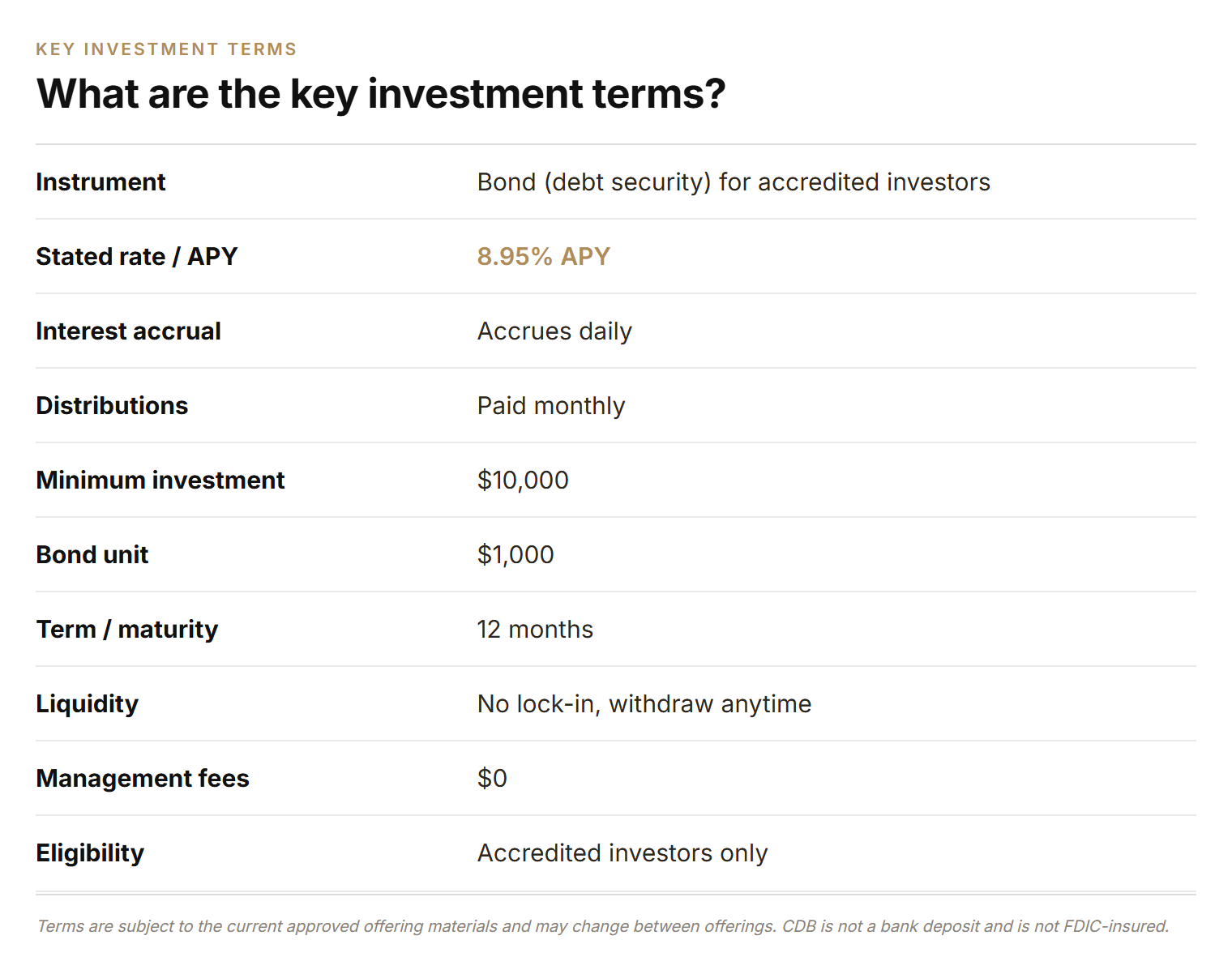
What are the key investment terms?
Every figure below must be verified against current approved CDB materials before publication. Terms can change between offerings.
What are the principal risks?
CDB carries the risks common to credit and private-market investing. These include possible loss of principal; credit and default risk if borrowers or counterparties fail to pay; liquidity risk, because private holdings cannot be sold as quickly as public securities; private-market and valuation risk, since some assets are not priced continuously by a public market; manager risk, since outcomes depend on the decisions of Compound and any underlying managers; and general market and interest-rate risk.
No diversification approach removes these risks. A multi-asset structure is intended to reduce dependence on any single source of return, not to protect it against loss. Investors should read the full risk disclosures in the offering materials.
Who may consider CDB?
CDB is available only to accredited investors: broadly, individuals or entities that meet the income or net-worth thresholds defined by the U.S. Securities and Exchange Commission. The design tends to suit investors who are seeking income, who understand private-market risk and illiquidity, and who are allocating capital they do not need for near-term or emergency use.
Nothing here is a statement that CDB is suitable for you specifically. Suitability depends on your full financial picture, and that is a decision for you and, where appropriate, your advisor.
What this means for investors
For an accredited investor, the practical value of CDB is access, a single security that packages income sources usually available only to institutions, managed as one portfolio with one income objective. That access comes with real trade-offs: reduced liquidity, exposure to private-market and credit risk, and dependence on the manager's judgment. The disciplined way to evaluate CDB is the same as for any income allocation: understand where the income comes from, what could interrupt it, how and when you can get your money back, and how the position fits alongside everything else you own.
Risks and limitations
CDB is a private, illiquid investment for accredited investors. It is not a deposit, is not FDIC-insured, and involves risk of loss of principal. The stated rate is not a guarantee of return. All product terms are subject to the current approved offering materials.


