

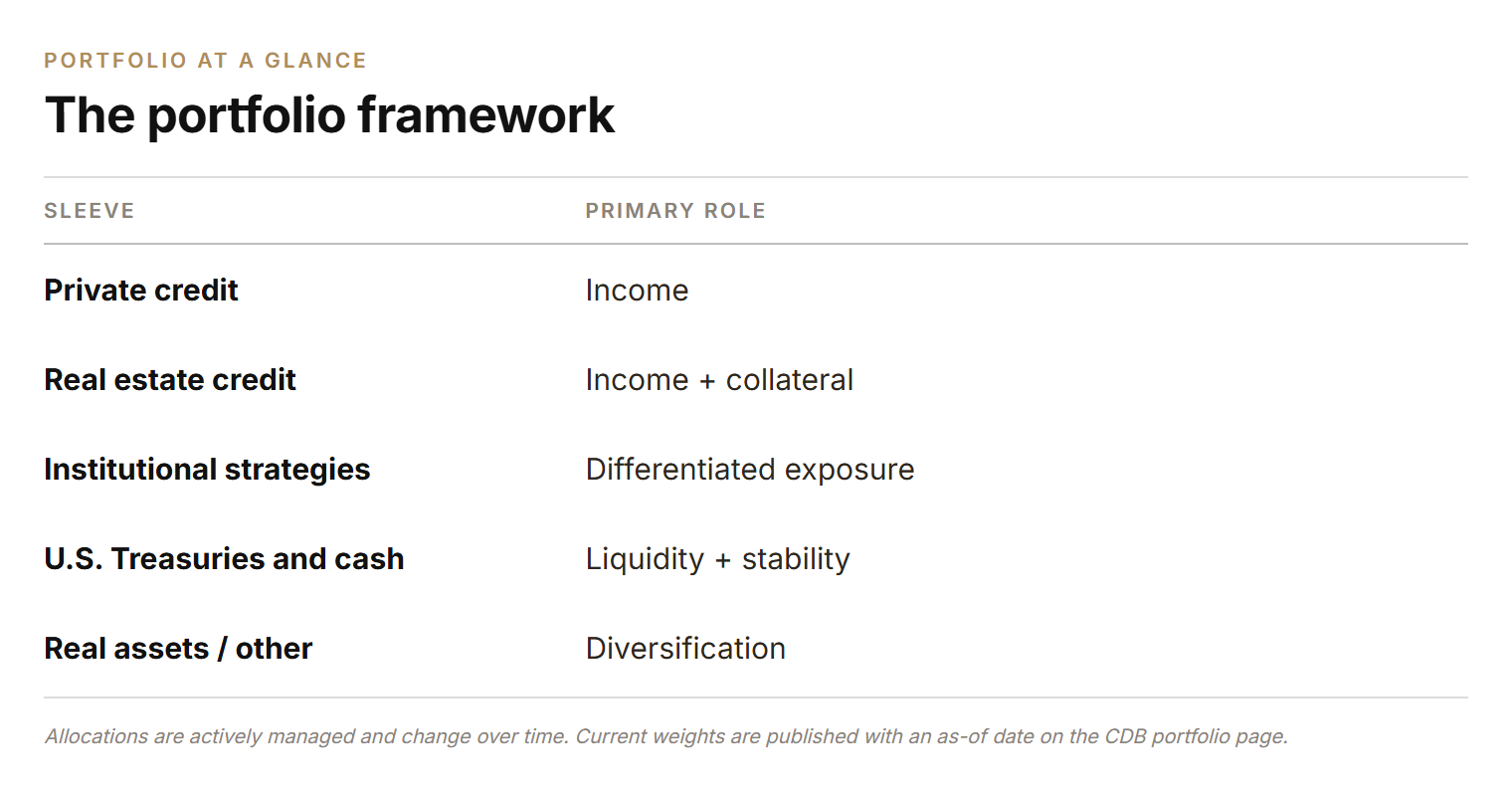
The CDB portfolio is a single multi-asset pool built to generate income while managing liquidity and risk. It is organized into several sleeves (private credit, real estate credit, institutional strategies, U.S. Treasuries and cash, and real assets), each holding a defined role. This article walks through what each sleeve contains and why it is there.
Key takeaways
- ▹The portfolio spans major sleeves, each with a distinct portfolio role.
- ▹Credit sleeves are the primary income engine; Treasuries and cash are held for liquidity and stability, not yield.
- ▹Allocations are actively managed and change over time; all figures here are dated and subject to the approved materials.
Portfolio at a glance
The framework below shows each sleeve and its primary role. Where an approved current weight is available it should be inserted with its as-of date; where it is not, the framework stands on its own without invented percentages.
Private credit
Private credit is the portfolio's primary income sleeve. It consists of privately negotiated loans. Because these loans are negotiated directly rather than traded on an exchange, they can carry structural protections and yields that differ from public bonds.
Its role in CDB is straightforward: to generate interest income. That income comes with credit risk and limited liquidity, which is why it is balanced by the more liquid sleeves described below.
Real estate credit
Real estate credit is lending secured by property. The presence of underlying real-estate collateral is a defining feature: if a borrower defaults, the lender has a claim on a tangible asset, though recovery is never certain and property values can fall.
In the portfolio, this sleeve adds income from a different source than corporate lending, with collateral characteristics that behave differently across cycles.
Institutional strategies
This sleeve allocates to underlying professional managers and vehicles that individual investors typically cannot access directly. The purpose is to add exposures and expertise that would be impractical to build in-house or as an individual, and to do so through managers selected by a defined due-diligence process.
Treasuries, cash and liquidity
U.S. Treasuries and cash are the lowest-yielding holdings in the portfolio, and they are held deliberately. Treasuries are backed by the U.S. government's credit and are among the most liquid securities in the world; cash is immediately available.
Their job is not income; it is flexibility. Liquid assets let the portfolio meet obligations, manage redemptions and act on opportunities without being forced to sell less-liquid holdings at a bad time. A lower yield on part of the portfolio is the price of that flexibility, and it is usually worth paying.
How the pieces work together
Read individually, each sleeve is a single bet. Read together, they are a system: credit sleeves supply income, Treasuries and cash supply liquidity and stability, and institutional strategies supply exposures the others cannot. The intended result is a portfolio whose income does not depend on any one borrower, sector or market condition, while accepting that all of these holdings still carry risk.
What this means for investors
The portfolio is where CDB's claims become concrete. For an investor doing due diligence, the useful exercise is not to look at the headline rate but to look at the holdings: what is actually in each sleeve, what income each is expected to produce, and what could go wrong with each. A portfolio that can explain the role of every sleeve, including the low-yielding ones, is showing discipline rather than reaching for yield. Because positioning changes, treat any allocation figure as a snapshot with a date attached, and check the current portfolio page before acting.
Risks and limitations
Allocations shown are as of the stated date and will change. Private credit and real estate credit involve credit, default and liquidity risk. Treasuries carry interest-rate risk. Representative holdings are examples and are not necessarily held as of any later date. See the offering materials for full disclosures.


