

The choice between public and private markets is often framed as either/or. It does not have to be. Public markets offer liquidity and transparent pricing; private markets can offer differentiated exposures and potential yield premiums. Because they do different jobs, an income portfolio can hold both, using liquid public assets for flexibility and private assets for income the public market may not provide. Both carry risk.
Key takeaways
- ▹Public markets provide liquidity and continuous, transparent pricing.
- ▹Private markets can provide access to exposures and potential yield not available publicly, with less liquidity.
- ▹Combining them is about complementary roles, not deciding which is better.
What are public markets?
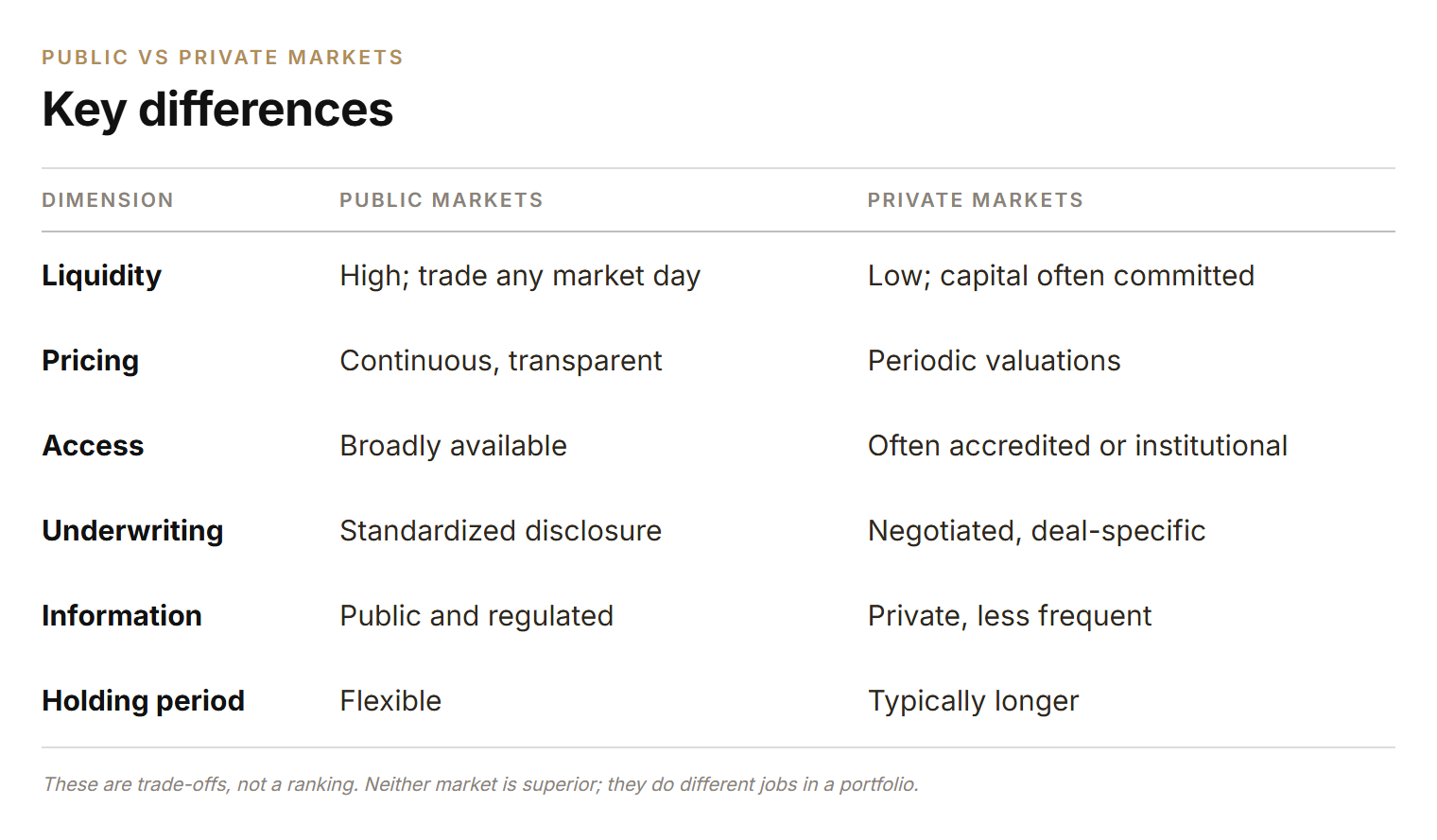
Public markets are exchanges and marketplaces where securities (stocks, government and corporate bonds) trade openly. Prices update continuously, disclosure is standardized and regulated, and most holdings can be bought or sold quickly. That transparency and liquidity are the defining strengths of public markets.
What are private markets?
Private markets involve assets that are not traded on public exchanges: privately negotiated loans, private funds, real estate and similar holdings. Deals are negotiated directly, valuations are performed periodically rather than set by continuous trading, and access is often limited to institutional or accredited investors. In exchange for accepting less liquidity and less frequent pricing, investors may access exposures and potential yield premiums unavailable in public markets.
Key differences
None of these differences makes one market superior. They describe trade-offs: liquidity and transparency on one side, differentiated access and potential premium on the other.
Why combine them in an income portfolio?
The two sides can offset each other's weaknesses. Public, liquid assets give a portfolio the ability to meet needs and act on opportunities without forced selling. Private assets can supply income and diversification that public markets do not. Held together, the liquid sleeve supports flexibility while the private sleeve works on income, a division of labor that either alone cannot achieve.
The trade-offs investors must understand
Combining public and private exposures does not erase the drawbacks of either. Private holdings remain illiquid, and periodic valuations mean their marks can lag reality; a smoother-looking price is not the same as lower risk. Public holdings remain subject to market volatility. And liquidity, even in public markets, is not guaranteed in every condition. Investors should size private exposure to capital they can genuinely leave committed.
How CDB combines public and private exposures
Compound Diversified Bond is structured around exactly this combination. Treasuries and cash form the liquid sleeve, held for flexibility and stability, while private credit, real estate credit and institutional strategies provide differentiated income exposure. The design uses each market for what it does best rather than betting on one.
A due-diligence checklist
- How much of the portfolio is genuinely liquid, and how quickly can I access my own capital?
- How are the private holdings valued, and how often?
- What is the intended holding period, and does it match my horizon?
- What differentiated exposure does the private sleeve add that I could not get publicly?
- How does the manager balance the public and private sides as conditions change?
What this means for investors
Investors are often pushed toward a false choice: the liquidity and transparency of public markets, or the access and yield potential of private ones. A well-constructed income portfolio treats them as complements. The public, liquid sleeve is the portfolio's flexibility and ballast; the private sleeve is where much of the income work happens. The trade-off to respect is liquidity: private exposures should be funded with capital you can leave in place, and you should never mistake infrequent valuations for lower risk.
Risks and limitations
Private markets are illiquid and valued periodically; smoother valuations do not mean lower risk. Public markets carry volatility, and liquidity is not guaranteed in all conditions. Combining both does not eliminate the risks of either. This is educational content, not a recommendation.


